
The Red Thread
A Discipline for Decision Quality in Complexity

Over the past few weeks, we’ve been circling a familiar experience.
Work that feels relentless rather than meaningful.
Meetings that are full but somehow inconclusive.
Strategies that still sound good on paper, yet feel harder to execute in practice.
These situations happen because we often stop caring or stop planning and the trigger tends to be the rapid pace that complexity change brings to the equation. Conditions are changing faster than most organisational cadence are designed to notice.
What we’ve been working toward in this series is asking ourselves to have a different way of paying attention, of making sense of the world around us.
This is the red thread.
A discipline for holding decision quality when everything else is in motion.
Let’s recap where we started this journey.
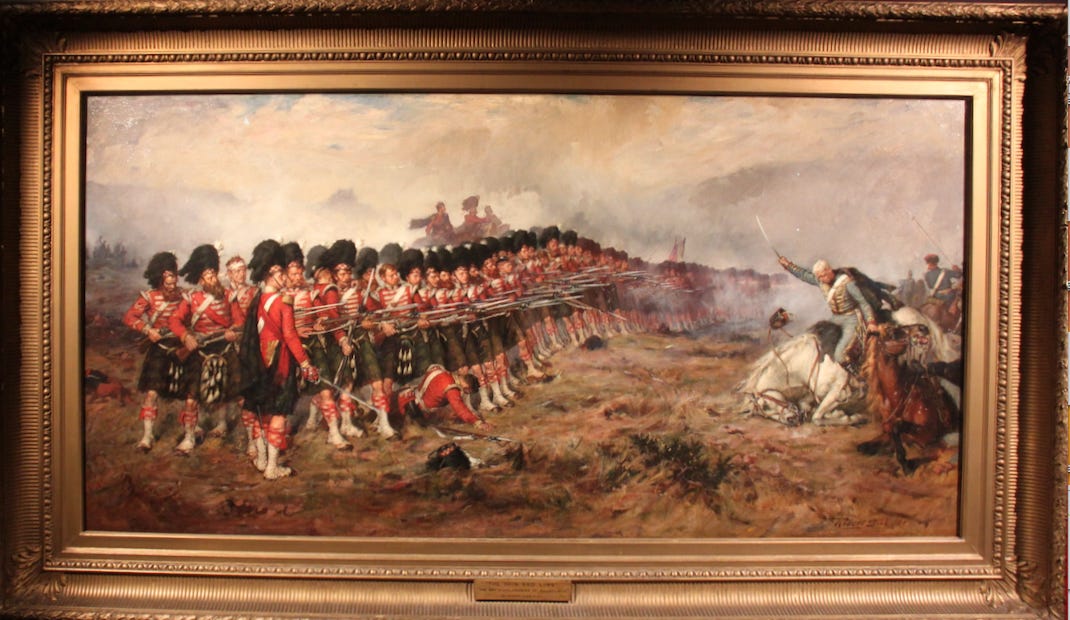
The painting that opened this Red Thread series wasn’t chosen from a book, a search, or by the more recent use of the phrase Thin Red Line by the media and European leaders. I photographed the painting myself, standing in the Scottish National War Museum at Edinburgh Castle in December 2025. The museum placard beside Robert Gibb’s The Thin Red Line — donated to the museum by Diageo Scotland Limited, points to the fact that it was painted in 1881, a full 27 years after the battle it depicts.
What struck me then, and stays with me now, is that Gibb painted it from inspiration and record, not from presence. Yet the discipline of that thin red kilted line — two men deep, holding a wide front against Russian cavalry at Balaclava in 1854 — was already so firmly established in the public imagination that the image needed no explanation.
There is also a personal reason why this painting and the idea of a Red Thread are important. More of that later.
So let’s recap what a red thread discipline consists of.
First, notice when work turns corrective
When decisions are shaping the future, work has a different feel. There is momentum, even when it’s demanding. We are energised, engaged, and squarely in U-Stress territory that positive friction state.
When decisions are repairing the past, work becomes heavier. More urgent. Less forgiving and quickly shifts to burnout if we don’t put in play those things that can help us stablise our emotional reaction to the situation.
Repairing the past remind us that urgent choices were deferred, and the invoice for that choice has now arrived.
Establishing a red thread approach begins by recognising what kind of decision work we are doing. It is certainly not asking us to work harder, a red thread approach is asking us to think better.
Second, pay attention to where decisions dissolve
Red threads rarely snap. They fade.
They fade when meetings fill with updates and commentary, but no one is quite sure what actually changed as a result. They fade when alignment replaces closure, and when discussion is mistaken for progress.
This is why turning talk into action matters. Not everywhere, but in the right places.
A red thread is held in place by decisions that check assumptions, clarify trade-offs, close loops, and change what happens next.
Third, return to assumptions before urgency does it for you
Most teams are scanning the environment constantly. Signals are noticed, reports are read, dashboards are reviewed. What’s often missing is judgment.
Strategies are set adrift when the assumptions that made them sensible are left untouched while execution carries on. Returning to assumptions and checking the judgment made at that time, is how we recalibrate without overreacting.
We also need to do this as a simple, repeatable practice that sits alongside delivery rather than waiting for an annual review.
Fourth, use scenarios to interrupt automatic execution
Scenarios earn their place when they do one thing well.
They interrupt momentum long enough to ask: what if this continues, what breaks first?
A miss test on the critical path exposes where pressure will move, not whether the plan looks good. It reveals how tightly coupled the system really is, and where sequencing matters more than ambition.
This is about stress testing our judgment.
Finally, make space inside the work, not outside it
None of this requires more process.
When we preserve decision quality we don’t need to add more forums. We can repurpose moments that already exist by.
using the first ten minutes of a meeting to orient thinking.
separate sensing from deciding instead of collapsing both into one conversation.
close meetings by naming what now holds, what has changed, and what will be revisited.
Over time, this changes how we all experience work as there is more coherence and fewer surprises.
Concluding thoughts
Taken together, these red thread practices form a single discipline.
Notice when work turns corrective rather than directional
Identify the objective that carries second order effects
Revisit the assumptions that made the plan sensible
Stress test the critical path through plausible misses
Protect decision quality inside existing forums
It is our way of stewarding judgment in environments where conditions move faster than reporting cycles.
A red thread helps us move through complexity with judgment intact.
Decision quality strengthens when we actively steward the assumptions, sequences, and conversations that shape what happens next.
A Personal Note
My connection to The Crimean War (the original) and the battles of Balaclava, Alma and Inkerman, runs deeper than a museum visit. Both my great grandfather’s were there. Felix McCarthy was in the 21st Foot Royal Scots Fusillers, and Gunner Henry Hubbard was on the HMS Trafalgar and received a Crimean War medal for his service at the Battles of Balaclava and Inkerman. A medal I grew up knowing about in a family that also taught me to recite Tennyson’s The Charge of the Light Brigade. That poem, with its valley of death and its unflinching soldiers, was my first encounter with what it looks like to hold a line under impossible conditions.
That is what this series has really been about.
Not a battle, but the discipline of knowing where to stand, what to protect, and what must not break, especially when the conditions around us are moving faster than our plans anticipated.
The red thread is that line.
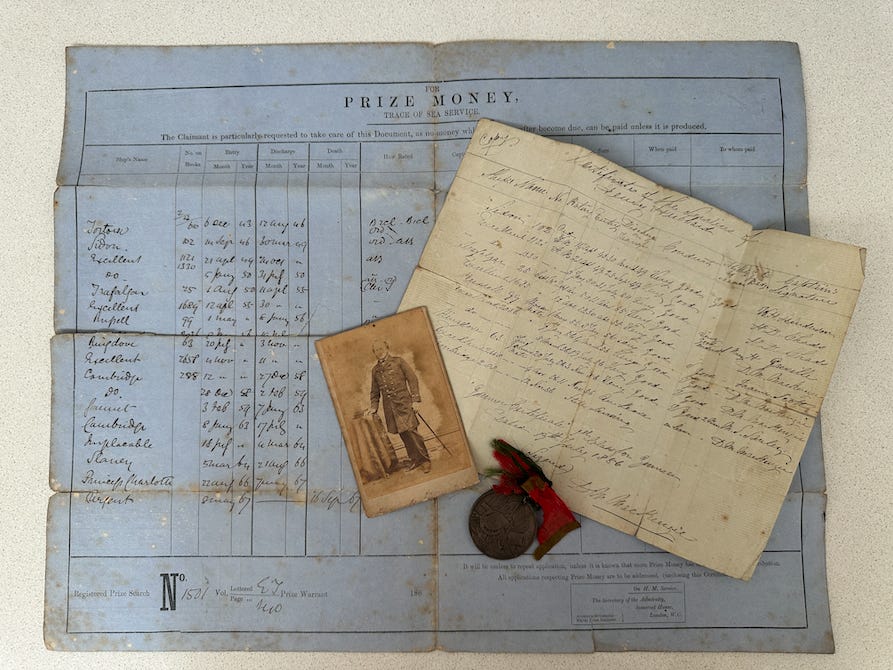
The Turkish Crimean War medal, duty records, and Gunner Henry Hubbard — my great grandfather, who served on the HMS Trafalgar involved with the Bombardment of Sevastopol as well as the land based Naval Brigade that fought in the Battles of Balaclava and Inkerman, 1854.